ICYMI: Oscars edition Looking for (but often not finding) queer appeal in some of the frontrunners for this year’s Academy Awards
Reviews by Arnold Wayne Jones
The Academy Awards are almost here, and the slate each year provides a snapshot of the culture at large – sometimes positively for queer folks, sometimes not so much. We decided to preview some of the top competitors.
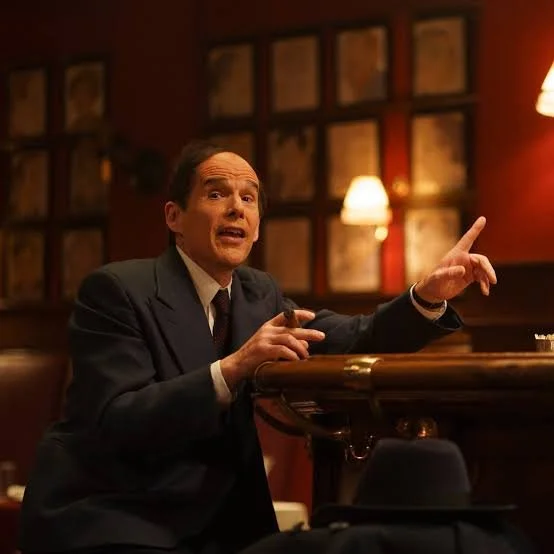
The gayest of the movies up for some major awards this year is probably Blue Moon, the character study of tortured, closeted lyricist for much of the Great American Songbook, Lorenz Hart. A master storyteller in a three-minute idiom, Hart was a flamboyant, alcoholic, often profane wit, and the film captures its subjects inherent contradictions: about “Blue Moon,” perhaps his most popular song, he expresses embarrassment if not outright regret; while he titled a song “My Funny Valentine” to sound either comic or romantic, he let composer Richard Rodgers set it in the melancholy key of C Minor. In ways such as these, the film captures the desperation and sadness often reflected in his songs, as well as the frustration, affection and borderline pity of those who surround him.
Director Richard Linklater stages everything like a play: Basically a single setting (the bar at Sardi’s after the opening in 1943 of Rodgers & Hammerstein’s revolution musical Oklahoma!), playing out in real time, as denizens of Broadway filter in and contend with Hart’s barbs, couched praise and ironic observations. Robert Kaplow’s Oscar-nominated screenplay unfolds like modern-day William Saroyan with tons of Easter eggs hidden among all the celebrity cameos.
Much of the heavy lifting rests on the shoulders of Oscar nominee Ethan Hawke, who flits around as an effete little man, crowing of a sexual conquest with a college coed (Margaret Qualley) whom everyone rightly suspects is more protege than paramour. Hawke’s affectations and pained reactions show a profoundly unhappy man in a closet with the door cracked open, taking a hard assessment of his life (Hart would die before the end of the year). It’s all so Hart-breaking.
Probably no best picture nominee addresses queer life more directly than The Secret Agent, the Brazilian political thriller set in the late 197os, when its authoritarian government criminalized dissent, homosexuality (especially presented in a fairly explicit, if absurdist, cruising scene) and every perceived disruption to the social order its right-wing leaders’ whims could conceive. The central story deals with college professor Armando, aka Marcelo (nominee Wagner Maura), who returns to his hometown of Recife to escape persecution because of his forcefulness in defending his independence concerning adacemic research.
Writer-director Kleber Mendonca Filho incorporates unexpected imagery in what could look like a straight-forward docudrama: A housecat born with two faces, rotting corpses reprseenting the putrefecation of society, and of course the unfairly targeted gay community, all of which serves the themes of duality and hypocrisy that threatens the simple act of living your life authentically. Sound familiar?
If you missed Sinners — and you probably didn’t if you were interested in movies or pop culture over the last year — you recognize that its homoerotic quotient is pretty low… except that you get by osmosis simply by (a) being about vampires and (b) starring Michael B. Jordan. Nevertheless, its absolutely gobsmacking energy transcends genres and genders: Sinners was one of last year’s most compelling watches.
Part of the wonder of the film is that so much – and so little – is going on. Virtually all of it takes place over the course of a single 24 hour period in October 1932, when twin brothers Smoke and Stack (both Jordan) return to their small Mississippi town after having worked as enforcers in Chicago for Al Capone. They reappear with little explanation but tons of suggestive backstory, determined to immediately open a jukejoint for the working class Black patrons, including the women each man left behind. Then vampires show up.
If it’s superficially a horror film, it’s tempermentally a thoughtful melodrama about outsiderism, loss, struggle, faith and, ultimately, race. Like Jordan Peele’s Get Out, Sinners investigate themes of pride, artistic integrity, vision and morality with a pulsating unpredictability. Writer-director Ryan Coogler takes huge swings, keeping his audience off balance by toggling between Ultra Panavision wide screen and a beefed up academy ratio to contrast between the intimate and the epic, with the costuming, color saturation and edits at unexpected times – a vampire lifts off the ground, about to attack, then we smash cut away from the violence – make for compelling cinema. No wonder its up for a record-setting 16 Oscars. Sinners is a visionary and creative artistic enterprise.
Director Guillermo Del Toro isn’t so much a creative artist as an interpretive one. Most of his films are adaptations — from comic books (the Hellboy and Blade movies), literature (Pinocchio), even other movies (Nightmare Alley and his reimagining of Creature from the Black Lagoon, The Shape of Water). As a director, he builds his inspiration on others’ foundations. His latest, Frankenstein, has a painterly beauty (some shots echo paintings by Gainsborough or Goya) that eventually challenge the viewer to ignore thinking, “He’s cribbing from Branagh’s version, Coppola’s Dracula … even Doctor Strange.” His love of movies stands in the way of his individuality; Mary Shelley famously wrote nothing about how the creature was brought to life; Del Toro spends half an hour on it, making the scenes as moist and sinewy as a slaughterhouse, because… well, because he can. At least Del Toro is a master craftsman: He steals from geniuses, and does so expertly.
In this telling, Victor Frankenstein (Oscar Isaac) is an erstwhile mama’s boy whose resentment over his father’s wanton cruelty and carelessness during childbirth leaves him defiant. From the moment Isaac replaces the child actor as his younger self, his “mad scientist” persona takes over. There’s little humanity behind his mania … which, of course, is the ultimate irony, as Dr. F famous mimics humanity with his creature (nominee Jacob Elordi). That’s always the twist, isn’t it: We care more for the artificial man’s suffering than for his creator’s fits of pique. Of course, one reason for that is Elordi’s sculpted, towering frame, clad modestly in a large napkin, imbuing the appropriate amount of homoeroticism into this man-on-man horror show. Frankenstein is a nice looking movie without much heart.
The act of titling your film something as flat-footed as F1: The Movie is as much a declaration of the makers’ ethos as it is a clarification (like, were we going to an IMAX and accidentally think we’ll be watching an actual race? Or is that to differentiate it from the macro on the upon row of a keyboard?). F1 is what I have dubbed a “commotion picture:” Noisy, unsubtle, predictable, with concepts cobbled together by a committee into putative scenes. No cliche goes unrepeated, no speech of trite exposition trimmed to give us a reasonable runtime (F1 clocks in at nearly three hours). It’s a garbage movie… Which isn’t to say it’s not enjoyable. Damson Idris offers a few scene of beefcakery and even slathered in a loose-fitting leather speed suit, Brad Pitt excudes BDE. (The downside of all the fuel-injected testosterone is a movie that exemplifies the kind of toxic masculinity and misplaced bro-ey oneupsmanship that’s polluting our real culture more than the fossil fuel-burning cars at its center. Still, despite a meaningless “best picture” nomination, F1 is a shoo-in for the best sound Oscar, with all its revved engines and squealing tires. I’m OK with that; sometimes thinking stands in the way of a good sit.
Yorgos Lanthimos is no stranger to quirk, nor does he back away from an investigatively queer sensibility in his absurdist satires: The Favorite, Poor Things, The Lobster, and more. In his latest, best picture nominee Bugonia, he aims more for insane sentiment between two disturbed young men (Jesse Plemons, neurodivergent newcomer Aidan Delbis) who target a ladyboss (Emma Stone) with kidnapping, suspecting her of being an alien. The madness is both hilarious and disturbing, and once again Stone transforms her body for a daring character portrayal (hey, it won her an Oscar for Poor Things and she’s nominated again here). The film feels more trifling than its best picture nom suggests, but run-of-the-mill Lanthimos is worth more than peak Michael Bay.
There were many elements of Paul Thomas Anderson’s One Battle After Another that I enjoyed: the performance of Benicio Del Toro and especially Sean Penn (who compete against each other this year, with Penn the likely victor); tense moments on a highway; the underlying absurdity of a futuristic world riven with extremism and violence (not-so-futuristic nowadays). But, again, for its running time I’m not sure it all comes together. It’s position as a darling of the Academy is, frankly, puzzling, and not just because there’s also not much here for queer audiences to revel in. It’s one battle ultimately not worth fighting.
Blue Moon and Frankenstein available on Neflix.
The Secret Agent available on Disney+/Hulu.
Sinners and One Battle After Another available on HBO Max.
F1 available on AppleTV+.
Bugonia available on Peacock.